
Visual Stress Assessments
Common in children, and often missed.
What is visual stress?
Visual stress, also known as Meares-Irlen syndrome or scotopic sensitivity syndrome, is a condition where the visual cortex becomes overstimulated by certain patterns, particularly the regular, high-contrast lines of printed text.
It is not an eye problem in itself, and your prescription might be perfectly fine. But reading still feels uncomfortable, tiring, or even painful, and it can hold back performance at school and at work.
- Affects approximately 20% of the population
- Around 30% of people with dyslexia or specific learning difficulties also experience visual stress
- Not caused by poor eyesight. Your prescription may be entirely normal
- Affects children and adults equally
- Often mistaken for dyslexia, ADHD, or simply disliking reading
Try each distortion on the reading sample. If any of them look familiar from your own reading, give us a call.
Reading should feel effortless. The eyes move along each line in small, quick steps, pausing briefly on a word before travelling on to the next. Most people never notice this happening. The print stays still, the page stays calm, and the meaning simply arrives. For a comfortable reader, a full page of text asks no more effort than a single sentence, and an hour with a book passes easily.
Distortion
Understanding visual stress symptoms
Learning and reading challenges
Visual stress can cause difficulties for both children and adults when learning and reading. Some challenges may include:
- Lack of focus from difficulty seeing the whiteboard at school
- Danger from not being able to see upcoming road signs
- Confusion with words moving around on your pages
- Problems tracking or copying words and text
Light sensitivity (photophobia)
There are many environments where light sensitivity can occur whether indoors or outdoors. Some light sensitivity symptoms include:
- Needing to close your eyes or look away when reading so your eyes can readjust
- Finding pages too bright when you're reading, causing you to squint
- Finding patterns difficult to look at, particularly stripes
- Getting sore and irritated eyes when reading
Headaches and migraines
Unfortunately, headaches and migraines can be caused by several factors. Visual stress may not be your initial thought when deciphering your symptoms. Headaches caused by visual stress may include symptoms such as:
- Squinting and straining your eyes, causing you to overuse your eye muscles
- Sparkling or shimmering areas, blurred vision, zigzag lines, or blind spots
- Colours, lights and patterns that are difficult to look at and focus on
- Nausea, dizziness and, in some cases, vomiting
What is colorimetry?
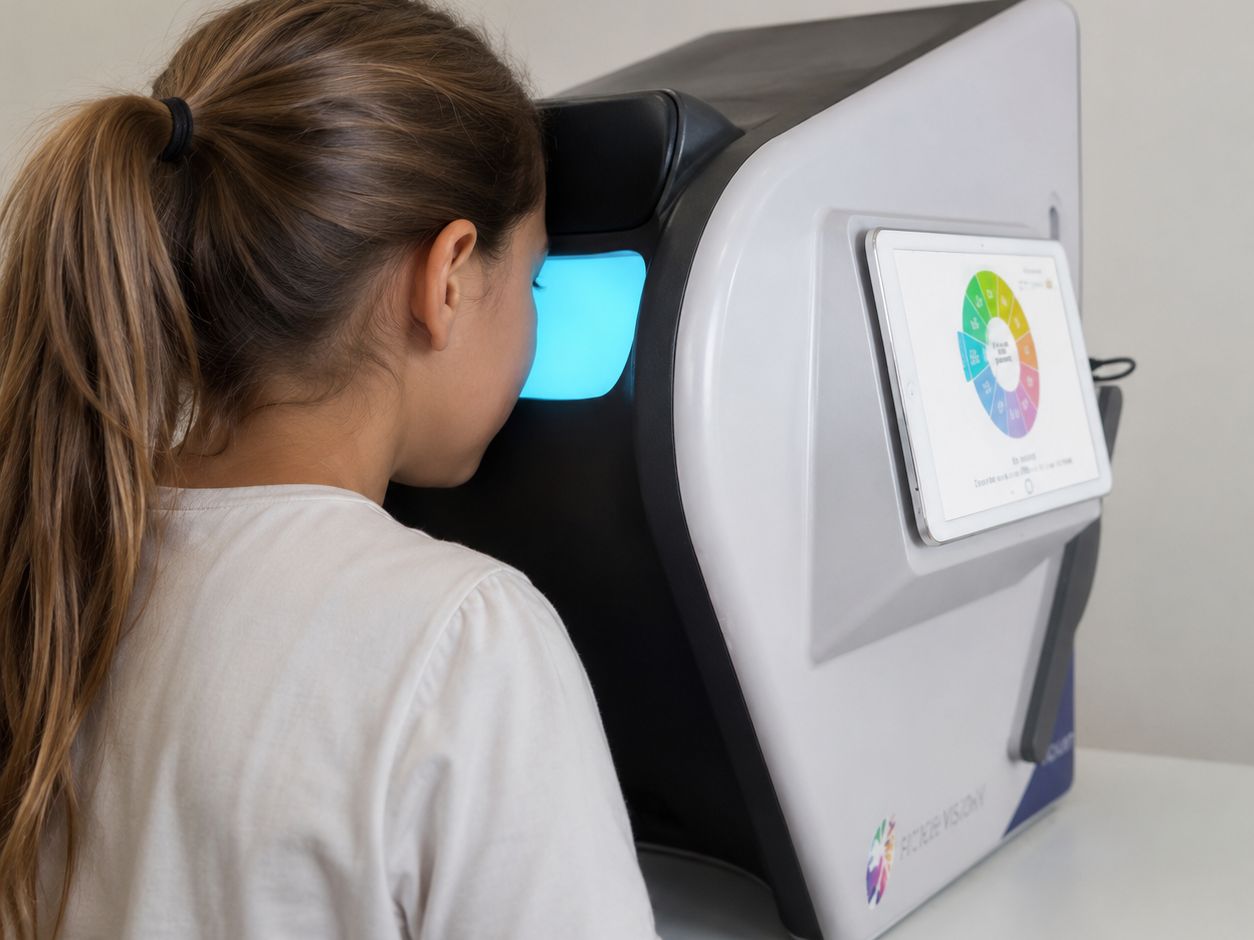
Colorimetry is the search for the one colour of light that calms visual stress for a particular reader. For some people the right tint holds the print still and takes the glare out of the page. The wrong tint does nothing at all, and there is no way to predict which it will be. It has to be found.
The assessment is carried out on the Cerium Intuitive Colorimeter. With the room lights off, Paul introduces coloured light over a page of text and you score each one against plain white light. He works through the hues one by one, then adjusts how deep or how light the colour is, until one clearly makes reading easier. That colour is then matched from a set of trial lenses before being made into your own tinted glasses.
- Guided by your own scores, not guesswork
- Precise tints, not simply “blue” or “pink”
- Built into your regular glasses, so one pair does everything
Try a tint
A page of clear, quiet text. Nothing drifting, nothing glaring. Just words that stay exactly where they were put, for as long as you need them to. For most readers a white page is simply a white page. For others it is the brightest thing in the room, and the print has to fight it to be read. Try a colour underneath and watch this paragraph change.
Currently: no tint
Seven colours here. A real assessment searches thousands to find the one that helps, if colour is going to help at all.
What to expect
Colorimetry is done over two appointments, about six weeks apart.
Appointment 1: eye examination and overlays. A full eye examination first, to rule out anything else causing the symptoms. Then we test your reading through coloured overlays. If one helps, you take it home to use for about six weeks.
Appointment 2: the colorimeter. In a darkened room, Paul finds the exact colour of light that works for you, then matches it in trial lenses. That tint is made into your glasses.
- Consultation 1: $275
- Coloured overlay, if one helps: $30
- Consultation 2: $375
Call to book · (08) 9399 5346
Our online booking is for standard eye examinations. Call us to arrange a colorimetry assessment with Paul.
Ready?
Reading shouldn't feel this hard.
Give us a call and we will arrange an assessment with Paul at our Armadale practice.
Visual stress assessments are booked by phone. Our online booking system covers standard eye examinations only.